
In compliance-heavy industries, notarization is not treated as a routine task. It’s part of how risk is managed.
A document is not just signed and stored. It needs to be verified, recorded, and traceable. Every action taken during the session can matter later, even if nothing seems unusual at the time.
That’s what makes these workflows different. In less regulated environments, the goal is to complete the process. In compliance-driven ones, the goal is to make sure the process can be trusted after it’s done.
That includes how identity is verified, how documents are handled, how sessions are recorded, and how everything can be reviewed later if needed. If any of those elements are inconsistent, the process becomes harder to rely on.
Compliance Extends Beyond the Session
A notarization session is only one part of the picture. What happens before and after is just as important. Before the session, documents need to be prepared correctly. Required fields must be present. Signers must be verified using methods that meet regulatory expectations.
After the session, records must be stored in a way that preserves their integrity. Audit trails must be complete. Data must remain accessible for future review.
That creates a longer chain of responsibility.
In practice, this means:
- Identity verification needs to follow consistent standards
- Document preparation must reduce the chance of errors before notarization
- Session activity must be recorded in full, without missing steps
- Stored records must remain secure and retrievable
If any part of that chain breaks, the issue may not appear immediately. It often surfaces later, when verification is required.
The Risk Shows Up After the Process Is Done
Most compliance issues don’t interrupt the session. They appear when the process is reviewed. That can happen during an internal audit, a regulatory check, or a dispute involving a document that was previously notarized.
At that point, the question is not how quickly the process was completed. It’s whether every step can be confirmed.
If identity verification is unclear, if documentation is incomplete, or if session records are inconsistent, the process becomes difficult to validate. That creates risk. And in regulated industries, risk accumulates quietly before it becomes visible.
What Compliance-Heavy Workflows Require in Practice
The requirements in these environments go beyond basic notarization. The system needs to operate in a controlled and repeatable way across all sessions.
That includes:
- Identity verification methods that are consistent and documented
- Document handling that reduces the need for manual correction
- Session recording that captures the full interaction
- Audit trails that can be reviewed without gaps
- Secure storage that preserves document integrity over time
The process needs to produce the same level of reliability every time it is used. That’s what allows organizations to trust it.
1. OneNotary
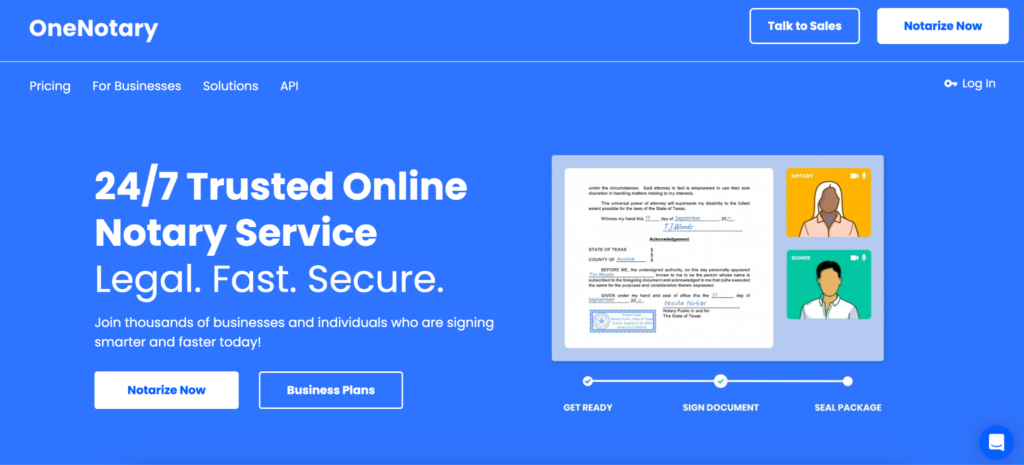
OneNotary is built to support workflows where compliance is part of daily operations.
The platform combines identity verification, document preparation, and session tracking into a structured process that remains consistent across repeated use.
This becomes relevant in industries such as financial services, legal operations, and real estate, where documentation must meet specific standards and be verifiable later.
In practice, the system focuses on reducing variation between sessions.
What supports that:
- Identity verification includes multi-step validation and biometric checks
- Documents are processed before the session to identify missing or incorrect fields
- Each session generates a detailed audit trail that records user actions and timestamps
- Document handling follows encrypted protocols aligned with enterprise security requirements
The result is a process that produces consistent records without relying on manual correction during or after the session.
2. Notarize (Proof.com)
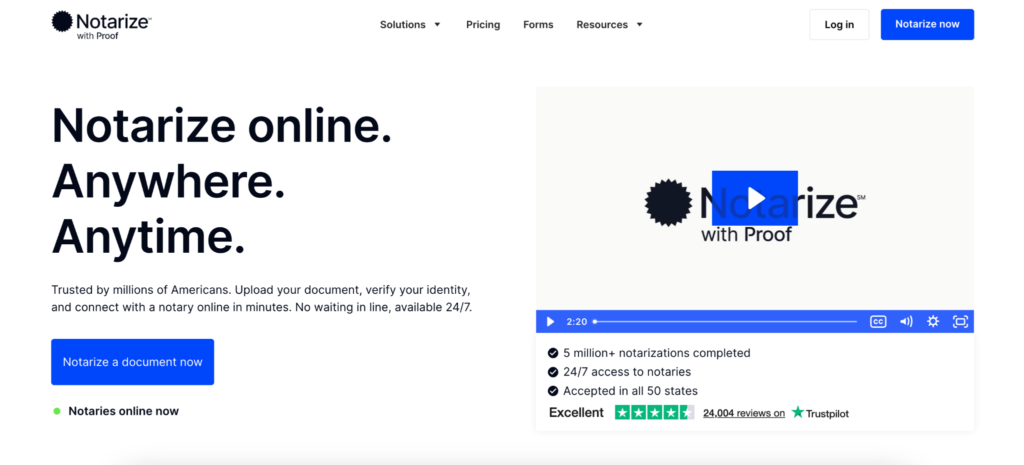
Notarize is often used in regulated environments where notarization must follow established frameworks.
The platform maintains a structured flow that supports identity verification, document handling, and session recording in a consistent way.
In practice, this helps organizations manage repeated transactions without introducing variation in how compliance steps are applied.
What that looks like:
- Identity verification follows defined procedures that remain consistent across sessions
- Sessions are recorded and stored for future reference
- Document handling remains stable even as volume increases
- Workflows align with real estate and financial use cases where compliance is required
The system is designed to maintain the same level of control across each transaction.
3. SIGNiX
SIGNiX is focused on document integrity over time.
In compliance-heavy industries, notarization is not just about completing a transaction. It’s about ensuring that documents remain valid and verifiable long after they are signed.
This changes how the platform is used. The emphasis is placed on long-term reliability.
What supports that:
- Identity verification processes are structured and repeatable
- Documents are stored in a way that preserves their integrity over time
- Activity related to each document is tracked and recorded
- Records can be reviewed later without missing information
This approach is relevant in environments where documentation may need to be referenced years after the initial transaction.
4. NotaryCam
NotaryCam is often used in workflows that involve more complex compliance requirements.
Some transactions include multiple participants, cross-jurisdictional elements, or additional verification steps that must be handled within the same process.
The platform supports these scenarios by maintaining structure rather than simplifying them.
What that involves:
- Support for sessions with multiple participants joining at different stages
- Structured handling of document sets that require detailed verification
- Secure recording of sessions for future reference
- Workflows that reflect legal and real estate requirements
The system is designed to maintain clarity even when the process itself becomes more involved.
5. DocuSign Notary
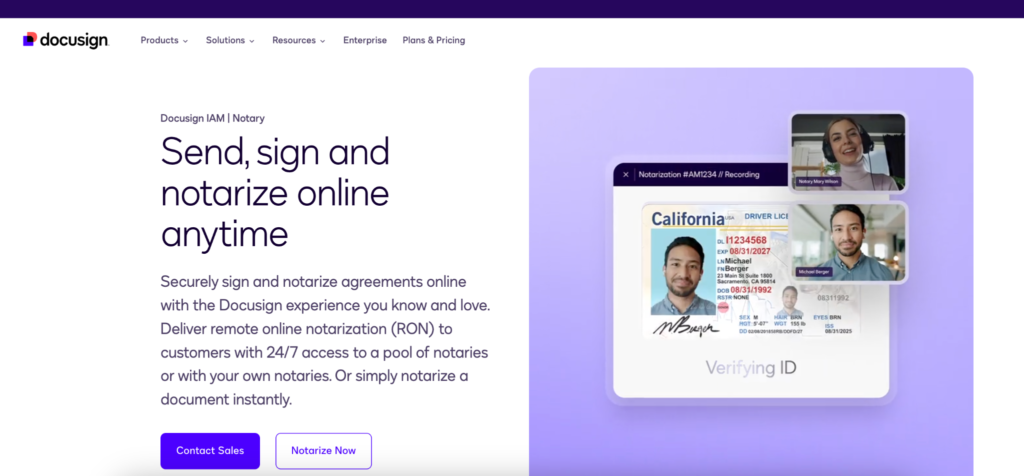
DocuSign Notary fits into environments where document management is already centralized and closely monitored.
In these cases, notarization becomes part of a broader system that tracks document activity, user actions, and approval steps.
This reduces fragmentation between different parts of the process.
What that changes in practice:
- Notarization is recorded within the same system that manages document signing
- User actions remain traceable across the full lifecycle of the document
- Documents are stored in a controlled environment with defined access
- Compliance processes can be managed within a single system
This approach helps maintain continuity across all stages of document handling.
Where Compliance Processes Start to Break
Breakdowns rarely come from a single failure. They come from small inconsistencies.
A document is handled slightly differently. A step is skipped or completed out of order. A record is incomplete or missing detail.
These issues don’t always cause immediate problems. But over time, they create gaps in the system.
And those gaps become visible when the process is reviewed.
Why Standardization Matters More Than Flexibility
In many workflows, flexibility allows teams to adapt. In compliance-heavy environments, it introduces uncertainty. If the process changes from one session to another, it becomes harder to verify later. Standardization reduces that risk.
It ensures that each session follows the same structure, produces the same type of record, and can be reviewed using the same criteria.
That consistency is what allows organizations to rely on the system.
Where AI Supports Compliance Without Changing the Process
AI is most useful in compliance workflows when it reduces the chance of human error. It doesn’t replace the process. It supports it.
In practice, this includes:
- Identifying missing or inconsistent information before the session begins
- Checking documents for issues that could affect compliance
- Reducing the number of corrections required during notarization
- Improving how documents are processed across repeated use
These adjustments help maintain consistency without introducing new complexity.
What Makes a System Hold Up Under Review
A compliant system is one that can be examined later without uncertainty.
That means:
- Every step is recorded clearly
- Every action is traceable
- Every document is complete
- Every session follows the same structure
When those conditions are met, the process can be verified without additional explanation.
When Compliance Becomes Part of the Workflow
At some point, compliance either requires constant attention or becomes part of how the system operates. If the process is structured correctly, it doesn’t need to be monitored at every step.
Documents are prepared correctly. Sessions follow the expected flow. Records are complete and accessible. If not, the process depends on manual checks and repeated verification. And in compliance-heavy industries, that difference becomes visible not during the session, but long after it has been completed.